

Children as Guardians of Nature
"Children are the most precious treasure a community can possess."
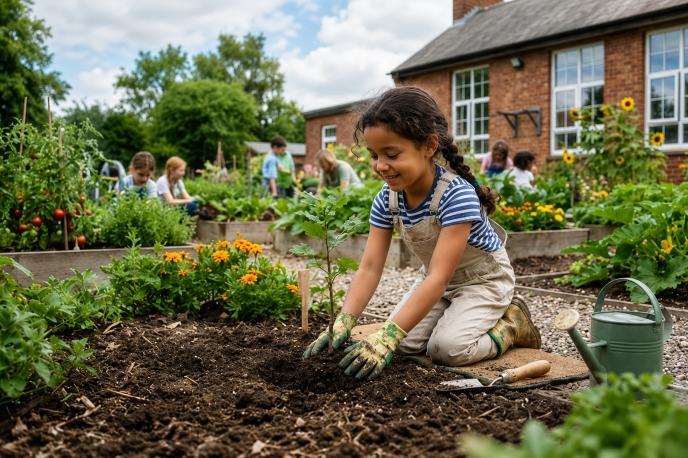
Environmental education in childhood is not just one lesson among many. It is the planting of values that can last a lifetime. The habits, questions, and sense of responsibility that take shape in a child’s early years accompany them into their homes, their communities, and eventually into the decisions they make as adults.
Natural resources are not abstract concepts. They are the soil that feeds families, the trees that clean the air, and the water that sustains daily life. When a child truly understands this, nature is no longer something outside their story; it becomes part of it.
The Workshop in Greece
In collaboration with Fund for Education, Planting Hope organized a Green Literacy Workshop at a school in Greece, helping children discover why trees matter through a simple coloring activity and an honest conversation.
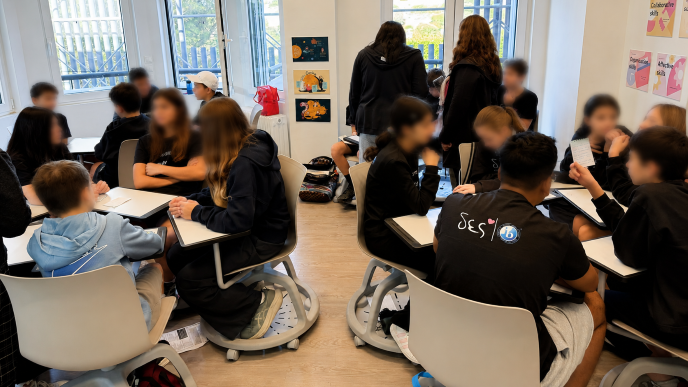
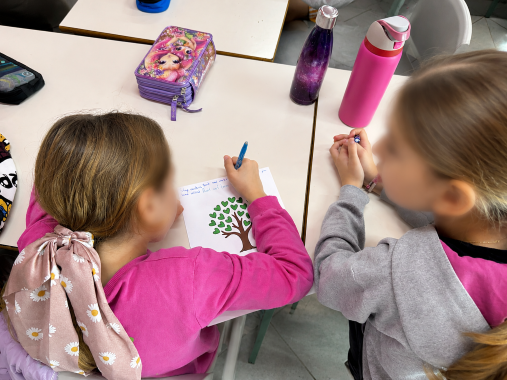
As the children colored the roots, trunk, branches, and leaves, they were encouraged to think carefully about what a tree provides: clean air, shade, habitat for wildlife, and protection for the soil.
The coloring activity became the starting point for deeper discussions. Questions emerged naturally:
Why are trees important?
Where do our natural resources come from?
What happens when we stop taking care of them?
What can each of us do to help, starting today?
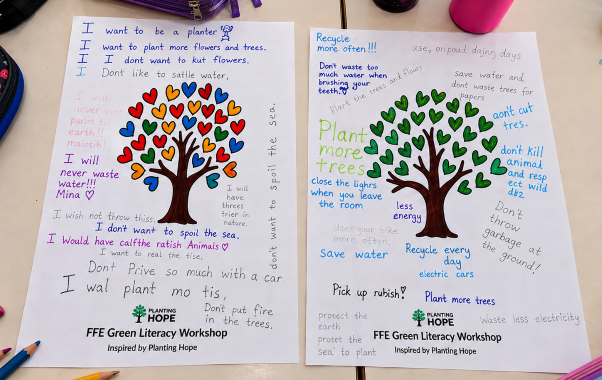
What happened next became the most meaningful moment of the workshop. Around their colored trees, the children began writing their own thoughts and commitments without prompts, in their own handwriting, and in their own words.
These were not answers to a test. They were personal commitments expressed freely by the children themselves. This is the power of a genuine conversation.
Why Teaching Respect for Nature from an Early Age Matters
The values that take root in childhood often stay for life. A child who understands that trees provide clean air, that healthy soil supports communities, and that water is a shared resource carries that understanding into adulthood.
Environmental education at this stage is not about rules or restrictions. It is about connection. When children see nature as part of their own lives, protecting it becomes a natural choice rather than an obligation.
The workshop in Greece was built on this principle: not to lecture, but to start a conversation. Not to give children ready-made conclusions, but to provide the space for them to reach their own.
From Knowledge to Action
One of the most powerful aspects of hands-on learning is its ability to bridge the gap between knowing and doing. A child who has spent time coloring a tree, reflecting on its roots and benefits, and writing a personal commitment has gone beyond simply receiving information. They have made it meaningful and personal.
Taking the time to carefully color a tree and examine each part individually creates a level of attention that spoken explanations alone rarely achieve. By the time the discussion began, the children were already engaged, not as an audience, but as active participants.
Theory became personal. Knowledge became intention.
A green heart-shaped tree displaying the message, “Every small step towards helping the Earth matters,” served as a fitting visual conclusion to the workshop.
Long-Term Impact
The impact of this kind of workshop extends far beyond the classroom. Children are often powerful advocates for positive change within their own families. They go home and remind parents not to waste water. They ask where food comes from. They begin noticing things they may never have considered before.
A single workshop can quietly influence far more people than the number of children present in the room.
A generation that understands the value of natural resources and feels personally connected to protecting them grows into farmers, parents, neighbours, and leaders who make different choices. Educational initiatives like these may be small in scale, but their long-term impact can be significant.
Looking Ahead
The workshop in Greece is only the beginning. Together with Fund for Education, Planting Hope will bring the Green Literacy Workshop to more schools in the coming months.
Each session is an opportunity to help a child better understand their relationship with the natural world and to recognise that caring for nature is inseparable from caring for themselves and their communities.
We do not need every child to plant a forest. What matters is that they understand why forests matter.
Sometimes, all it takes is a colored tree and an honest conversation.
The lessons children learn today become the foundation for the care, responsibility, and hope of tomorrow.
Would you like to support the Planting Hope initiative and help bring environmental education to more children across the world?
Contact us to learn more.
Green Your Inbox!
With our Newsletters, Stay updated on our Stories of Change and Growth.
As a gift, get a personalised Nature E-card from PH.